Searching for Food in Autumn
The hot summer months are over. The abundance of colour in our gardens has largely faded. As the flowers disappear, insects become less noticeable too. Yet life goes on. Many species remain active in autumn and still need to find food. Flowering plants play a particularly important role at this time of year, as nectar and pollen become increasingly scarce.
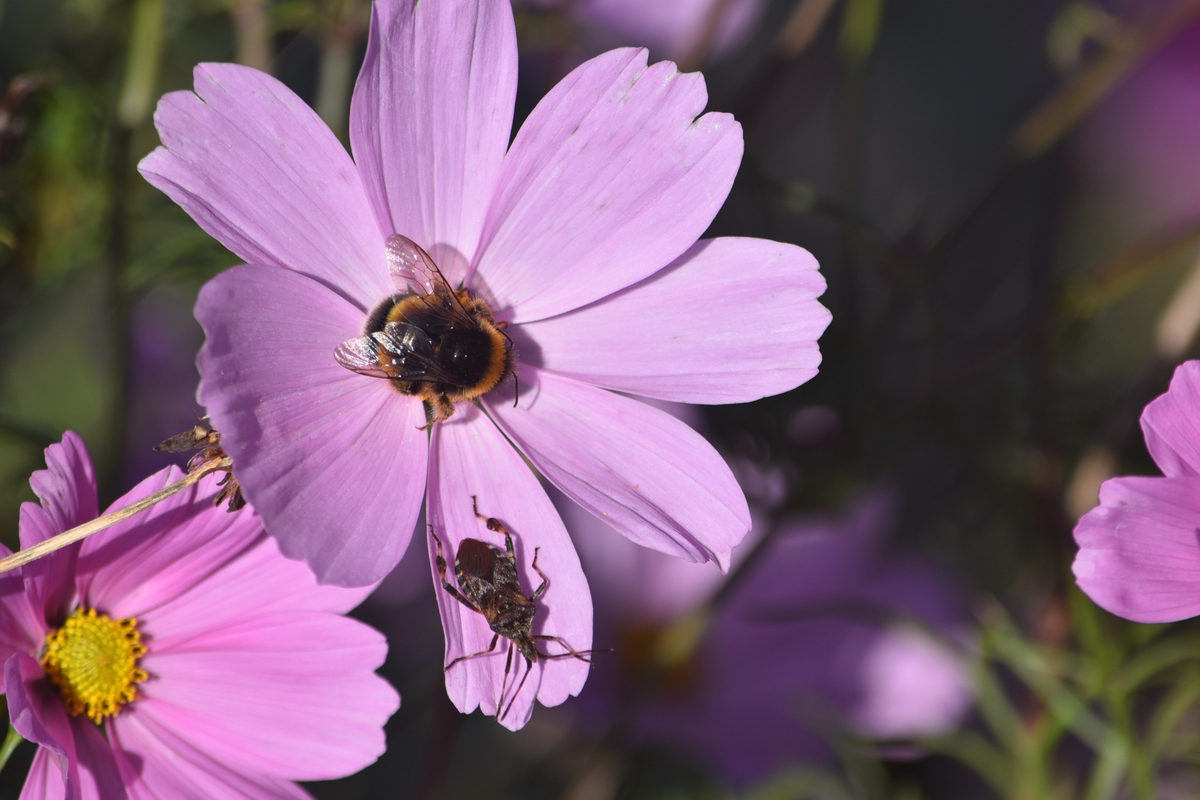
At the end of October, two visitors were observed on a cosmos flower (Cosmos bipinnatus): a bumblebee belonging to the Bombus terrestris species group and a true bug (Heteroptera). While the bumblebee searched for food in the centre of the flower, the bug rested on one of its pink petals.
The bumblebee uses its extendable proboscis to draw nectar from the small tubular flowers at the centre of the cosmos. Rich in sugar, this nectar provides the energy needed for flight. Bumblebees can also collect pollen, which becomes caught in the dense hairs covering their bodies. Females carry collected pollen in specialised baskets on their hind legs back to the nest, where it is used primarily to feed the larvae.
The bug, by contrast, has piercing and sucking mouthparts. Many true bugs pierce plant tissues to extract sap or fluids from seeds. Other species are predators, feeding on small insects. The diet of the bug in the photograph depends on its species. The observation does not establish whether it was actually feeding on the cosmos.