When Birdsong Fades: The 2026 Drought and Its Impact on Breeding Birds
An Unusually Quiet Summer
In 2025, birdlife on our property was still remarkably active. During the breeding season, numerous birds could be heard and seen. Song, territorial behaviour and the feeding of young filled the trees, hedges and shrubs with activity.
In 2026, this picture changed markedly as the drought intensified.
Bird activity declined. The surroundings became quieter. Some breeding attempts were abandoned, while other birds did not begin further nesting attempts of the kind observed the previous year.
It is not yet possible to establish how many young birds were raised or how many survived their first months.
These observations raise the question of how the exceptional drought affected the reproduction of local bird species.
The 2026 Drought in Brittany
Meteorological records confirm that Brittany experienced an exceptional dry spell in 2026.
After extremely wet months in January and February, the weather changed substantially in spring. March and April were already much drier. Rainfall brought temporary relief in May, but early heat towards the end of the month dried the soil out again.
The situation worsened in June and July. Rainfall was largely absent, while high temperatures increased evaporation.
According to the French regional environmental authority DREAL Bretagne, soil moisture reached historically low levels in mid-August. Conditions were particularly severe in Finistère and Côtes-d’Armor.
Since 14 August 2026, the department of Côtes-d’Armor has officially been under the highest level of drought alert, known as crise sécheresse.
Occasional rain in late summer provided only temporary improvement. In September, rainfall remained well below usual levels in many places.
For wildlife, the timing was especially significant. The drought developed during the breeding season and intensified over several subsequent months.
Less Water, Less Food?
For many bird species, drinking water is not the only concern. The effects of drought on their food supply are equally important.
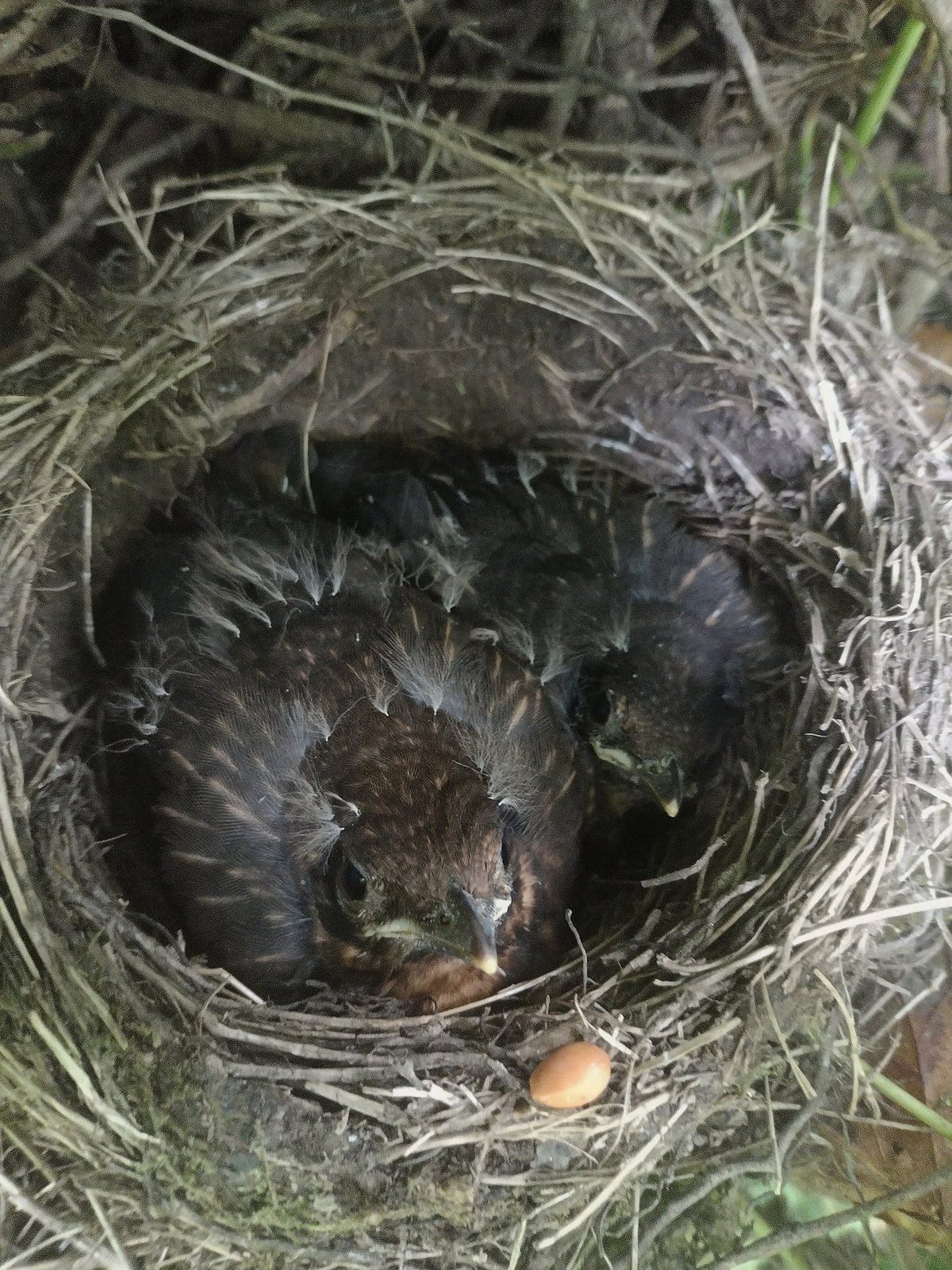
Blackbirds, for example, find much of their food on the ground. Earthworms, insects and other invertebrates are particularly important when they are raising young.
When the upper soil layers dry out, earthworms retreat into deeper, moister ground. They then become harder for birds to reach.
The development and activity of other invertebrates are also affected by temperature and soil moisture.
Food shortages during the breeding season can have several consequences. Adult birds must spend more time searching for food. Feeding nestlings may become more difficult. Under unfavourable conditions, the growth and survival prospects of young birds decline.
The French bird protection organisation LPO explicitly points out that food shortages during dry spells can cause problems for young blackbirds.
Without further investigation, however, it is not possible to demonstrate that the abandoned breeding attempts observed on our property were actually caused by a lack of food.
What Science Says About Drought and Breeding Success
A meta-analysis published in the Journal of Animal Ecology in 2024 examined the effects of drought on 204 bird species. The researchers assessed findings from 29 scientific studies.
Overall, drought had a negative effect on several demographic measures. Species feeding on invertebrates, fruit, nectar or a mixed diet were particularly likely to show population-level declines in numbers or reproductive performance.
The effects were far from uniform across species. Relevant factors included the duration and intensity of the drought and the ecological characteristics of the birds studied.
Another study from 2024 examined three North American songbird species during a severe drought in Kansas. Researchers found that breeding activity in several species was concentrated in the earlier part of the season. Later nesting attempts were largely absent.
Interestingly, the success of individual nesting attempts that had begun was not consistently lower than in wetter years.
The timing of breeding attempts is therefore also important.
An additional finding comes from France. A study published in 2025 by researchers at the Muséum national d’Histoire naturelle analysed data from more than 300,000 birds of 68 species collected between 1991 and 2022.
Its findings challenge the blanket assumption that drier springs are always worse for songbirds. Under the conditions examined, reproductive performance was often higher in warmer and drier springs.
The researchers also found indications of negative effects from high temperatures, particularly later in spring and in certain species.
These findings show why a moderately dry spring must be distinguished from a prolonged drought accompanied by extreme heat.
Documented Breeding Losses in Côtes-d’Armor
Observations from the Réserve naturelle nationale de la baie de Saint-Brieuc show that the exceptional conditions of summer 2026 had concrete consequences for breeding birds.
In a report dated 9 October 2026, the nature reserve’s management documented substantial losses among several bird species.
On the small island of Verdelet, 35 abandoned great cormorant nests were found on 29 June on the particularly sun-exposed south-eastern side. Dead chicks lay nearby.
Only six young from three nests had survived there.
On the more sheltered north-western side, by contrast, only about one-third of the nests had disappeared.
The contrast between the two sides suggests that exposure to heat played a significant role.
Increased losses were also documented among other seabirds. For the little ringed plover, high temperatures placed additional demands on adults tending their nests. At the same time, extreme conditions reduced the availability of invertebrate prey along the coast.
These findings concern different habitats and bird species from those in my observations inland. They therefore do not establish the causes of what I observed. They do show, however, that the weather extremes of 2026 had measurable effects on breeding bird populations in Brittany during the nesting season.
Common Moorhens: Successful Breeding Despite the Drought
The common moorhens on our property presented a different picture.
While breeding activity among various land birds declined noticeably, the common moorhens (Gallinula chloropus) continued to reproduce.
Two breeding pairs were successful. One pair raised chicks on two occasions, the other on three.
The seven young birds in total have continued to develop, and some are still present on the property in autumn. Several birds can often be seen together.
The fact that both pairs managed to raise young on our property despite the drought is a noteworthy observation.
One possible explanation is the continued availability of pond habitats. Where sufficient water, suitable waterside vegetation and food remain available, such water bodies can provide important refuges during dry periods.
This does not mean, however, that common moorhens are generally less affected by drought than songbirds.
Waterbirds are also at risk when water bodies dry up, bankside vegetation disappears or their food resources deteriorate.
The successful breeding attempts show, first and foremost, that local conditions remained favourable enough for these two pairs.
Less Birdsong Does Not Necessarily Mean Fewer Birds
The growing quiet on the property was one of the most noticeable changes of the summer.
Nevertheless, vocal activity alone is not a reliable measure of how many birds are present.
In many songbird species, singing naturally declines after the main breeding period. Moulting, changing activity patterns and seeking out shady refuges also affect how readily birds can be detected.
In high temperatures, birds may also shift more of their activity to the cooler hours of the day.
A decline in song therefore does not directly demonstrate a reduction in population size.
Specific observations of abandoned nests or the absence of further breeding attempts are different. They provide evidence of changes in breeding activity, even though the underlying causes are not always clear.
Reliable assessment requires repeated observations over several years.
What Might Become Visible in 2027?
At the end of October 2026, it is still impossible to assess the long-term effects of the drought on local bird populations.
Complete information is lacking both on breeding success and on the survival of young birds after fledging.
In many bird species, mortality is high in the first year of life. A successful nesting attempt therefore does not mean that all the young will survive until the following spring.
Emigration, immigration and natural year-to-year fluctuations in population size complicate the picture further.
Next spring will nevertheless be informative.
How many breeding territories will be occupied again? Which species will begin nesting? Will multiple broods be observed again? And how will the common moorhen population develop?
A comparison with 2025 and 2026 may provide initial clues. Establishing whether a genuine decline has occurred, and narrowing down its causes, would nevertheless require systematic surveys over several years.
The observations from the drought year of 2026 provide a starting point.
They already show that different bird species can respond very differently to the same exceptional environmental conditions, even within a single property.
Whether the changes observed are temporary or have a lasting effect on the breeding bird community remains an open question.
The observations will continue.
Sources and further reading
- DREAL Bretagne (2026): Situation hydrologique en Bretagne mi août 2026. Regional data on exceptional soil dryness, groundwater levels and streamflow. Original report
- Météo Bretagne (2026): 2026 : de l’excès de pluie à la sécheresse en Bretagne. Weather developments from January to September 2026. Original article
- Réserve naturelle nationale de la baie de Saint-Brieuc (2026): L’été 2026 : quand les chiffres racontent le réchauffement. Documented heat-related losses of breeding seabirds. Original report
- Zhang, L. B., Ma, Z. & Liu, Y. (2024): Biological traits and biome features mediate responses of terrestrial bird demography to droughts. Journal of Animal Ecology, 93, 1868–1880. Scientific study. Scientific study
- Smith, E. B. et al. (2024): Consequences of drought for grassland songbird reproduction. Ecosphere, 15(1), e4746. Scientific study. Scientific study
- Thepault, A. et al. (2025): Warm or Dry Springs (Still) Boost the Reproduction of Most Temperate Songbirds. Global Ecology and Biogeography, 34, e70138. Scientific study. Scientific study
- Ligue pour la Protection des Oiseaux (LPO): Merle noir and Gallinule poule-d’eau. Species profiles on feeding, reproduction and habitat. Blackbird · Common moorhen
Havre du Vivant | Field observations and biodiversity in Brittany, November 2026