An unmistakable forest dweller
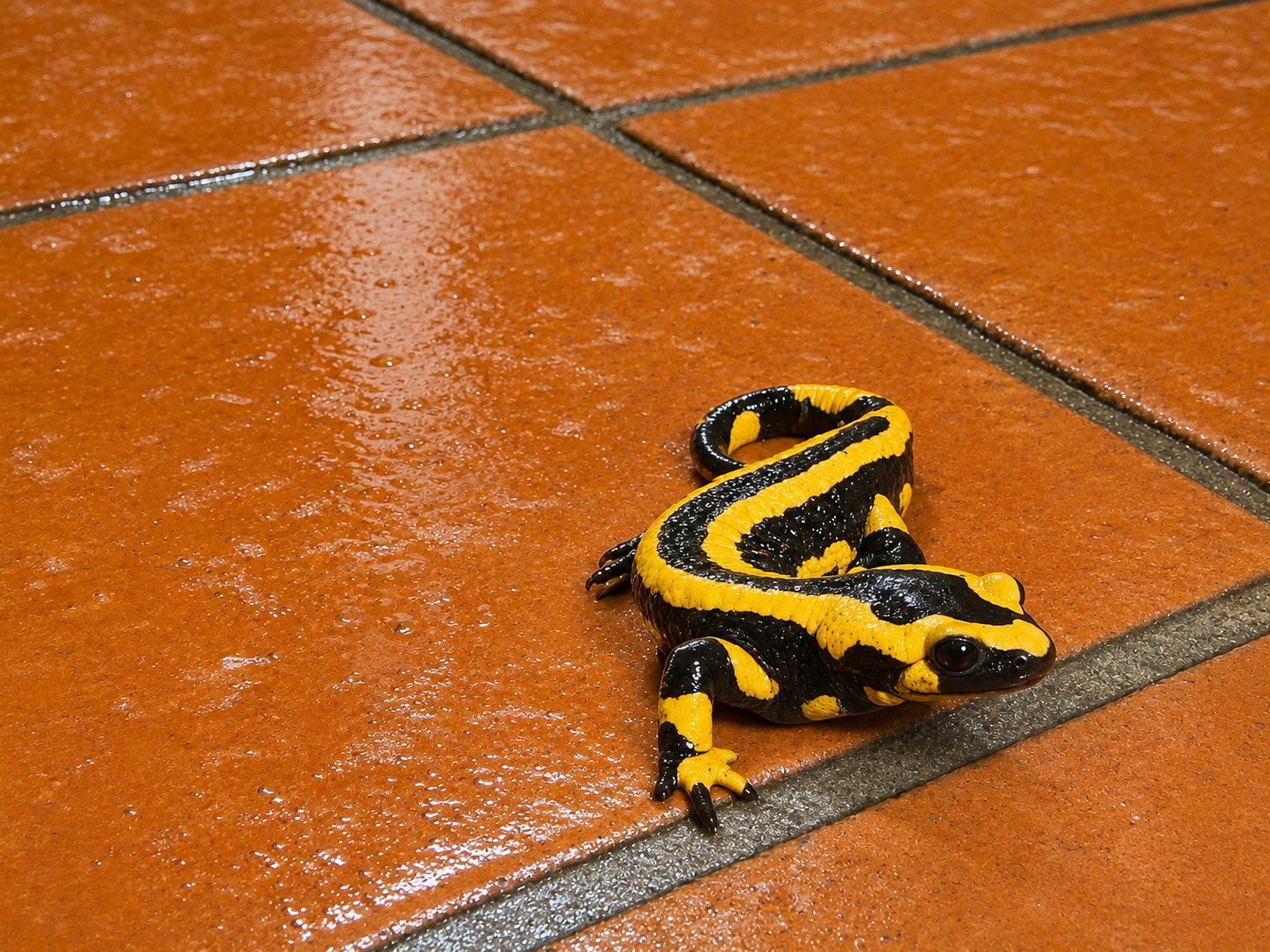
Against the wet terracotta tiles, its black-and-yellow body stands out clearly. With its stocky build, short legs and glossy skin, the fire salamander almost seems to belong to another age.
Adult fire salamanders are generally 15 to 20 centimetres long, occasionally reaching 25 centimetres. They belong to the family Salamandridae and are tailed amphibians.
Their striking colours serve a biological purpose. The yellow spots and stripes on a black background warn potential predators. Behind the eyes are prominent parotoid glands. Together with other skin glands, these produce toxic secretions that deter attackers.
An undisturbed fire salamander poses no danger to people. Nevertheless, it is best not to touch one, both for the animal’s protection and because of its skin secretions.
Growing up: From water to the forest floor
The fire salamander’s life cycle differs from that of many other amphibians.
Mating takes place on land, often during the warmer months. The female then carries the developing embryos inside her body for several months. Unlike most frogs and toads, she does not normally lay eggs in water but releases larvae that have already developed.
To do so, she seeks suitable water. Small woodland streams, springs, water-filled wheel ruts, ditches and pools can all serve as nurseries. Depending on the region and weather, larvae may be released from autumn through spring.
A female usually releases several dozen larvae, sometimes up to about 50.
Young salamanders look quite different from adults. They have external feathery gills for breathing underwater. Initially they are more grey or brownish, with pale marks at the bases of all four legs.
Over the following months, the larvae undergo metamorphosis. Their legs develop further, their gills regress and the characteristic yellow-and-black markings gradually emerge.
After roughly three to six months, the young salamanders leave the water. From then on, they spend most of their lives on land.
They do not reach sexual maturity until several years later. Under favourable conditions, fire salamanders live for 20 years, sometimes longer.
Habitat: Moisture, leaf litter and deadwood
The fire salamander inhabits damp, shady places. It is particularly at home in deciduous and mixed woodland with deep layers of leaves and humus.
By day, it shelters beneath rotting logs, among roots, in cracks in the soil or in abandoned small-mammal burrows. These hiding places protect it from drying out and from sharp changes in temperature.
It becomes active at dusk and during the night. Mild, rainy autumn evenings offer particularly good opportunities to see one. When humidity is high enough, fire salamanders sometimes appear in daylight too.
Although water is essential for reproduction, adults live mainly on land. They are not especially strong swimmers.
The connection between suitable terrestrial habitat and breeding waters is therefore crucial.
A structurally diverse forest with old trees, deadwood, damp hollows and small streams provides particularly favourable conditions.
Brittany’s traditional hedgerow landscapes, known as the bocage, also play an important role. They offer shady, moist refuges and connect smaller patches of woodland.
Diet: A nocturnal hunter
Fire salamanders feed mainly on invertebrates.
Their prey includes earthworms, woodlice, slugs and snails, spiders, beetles and various insect larvae. They generally find prey on the ground and seize it with their mouths.
They forage mostly at night, when many ground-dwelling animals are active too.
Aquatic salamander larvae are predators as well. They eat small crustaceans, aquatic insects and other freshwater invertebrates. Cannibalism sometimes occurs when food is scarce.
The fire salamander thus participates in two different food webs: as a larva in small aquatic ecosystems, and as an adult in the community of the forest floor.
Distribution: Fire salamanders in Brittany
In Brittany, the species is widespread and locally common. It inhabits wooded and hedgerow-rich landscapes across the region’s four departments, including Côtes-d’Armor.
Brittany’s climate is generally favourable. Mild temperatures, regular rainfall and relatively high humidity in many areas suit its ecological needs.
Small streams and wetlands in the interior of the peninsula are particularly important.
Yet the presence of a species tells us little about trends in its population. Even a widespread animal may decline locally when habitats disappear or deteriorate.
The conservation organisation Bretagne Vivante therefore supports monitoring of fire salamanders. During the autumn citizen-science initiative La Nuit des Dragons, volunteers record salamanders along designated survey routes.
Repeated surveys aim to show over time whether local populations are stable, increasing or declining.
Every pattern is unique
One especially interesting feature of the fire salamander is its individual body pattern.
The arrangement of yellow spots, bands and lines differs from one animal to another. These markings can therefore be used to identify individuals.
The same principle is familiar from research on large marine mammals.
Scientists photograph the underside of a humpback whale’s tail fluke. Its pigmentation, shape and scars allow individual whales to be recognised over many years.
Photo-identification of fire salamanders works on a comparable principle.
Researchers document the pattern on the back and compare it with existing photographs. Especially in adults, the markings remain stable enough to track individuals over extended periods.
A scientific study published in 2024 specifically investigated automated photographic identification of fire salamanders and their larvae.
Such methods are valuable in population research. By detecting the same individuals repeatedly, researchers can, under appropriate study conditions, estimate population size, survival and site fidelity.
This feature also interests amateur naturalists. Anyone who photographs a fire salamander from above and records the date and location may already have the basis for recognising the animal again.
There is no need to capture or mark the salamanders.
Its role in biodiversity
The fire salamander forms part of a complex ecological network.
As a predator, it influences communities of small invertebrates. Its larvae are also part of the food webs of small water bodies.
Its way of life shows how closely different habitats are connected.
A fire salamander needs suitable land habitat, enough food, protected hiding places and accessible water in which its young can develop.
If one of these elements is missing, successful reproduction becomes more difficult.
The presence of fire salamanders can therefore provide clues about the ecological quality and connectivity of damp forest landscapes. A single sighting, however, does not prove that the wider habitat is in good condition.
Threats and protection
The fire salamander is legally protected in France. Nevertheless, it faces several threats.
Wetland drainage, the loss of small water bodies and the removal of hedgerows and deadwood alter its habitats.
Road traffic is another problem. On damp nights, salamanders cross paths and roads. Their slow movements make them vulnerable to vehicles.
A pathogen is also an increasing concern in European amphibian research. The skin fungus Batrachochytrium salamandrivorans, or Bsal, has caused severe losses among fire salamanders in parts of Europe.
Protecting habitats and monitoring local populations are therefore both important.
On nature-friendly properties, simple measures help: retaining leaf litter and deadwood, preserving shady refuges, protecting small water bodies and avoiding pesticides.
An animal worth noticing
The fire salamander is neither so rare that every encounter is sensational nor so common that its habitat should be taken for granted.
Its life cycle demonstrates the close relationship between the forest floor and water. Its presence reminds us that biodiversity extends far beyond the birds, mammals and flowering plants we readily notice.
And its distinctive markings offer an especially interesting opportunity for nature observation.
Perhaps we will encounter the same salamander on another rainy night.
We would only need to recognise its pattern.
Havre du Vivant | Biodiversity and nature observation in Brittany
Sources and further reading
- Parcs nationaux de France: La salamandre tachetée. Biology, reproduction, diet, habitat and individual markings.
- Bretagne Vivante (2025): La Nuit des dragons : recenser la salamandre tachetée près de chez vous. Distribution, threats and scientific monitoring in Brittany.
- Schulte, L. et al. (2024): Performance of different automatic photographic identification software for larvae and adults of the European fire salamander. PLOS ONE, 19(4), e0298285. Research on identifying individual fire salamanders from photographs.
- NOAA Fisheries: Humpback Whale. Photograph-based identification of individual humpback whales using their tail flukes.
- Picardie Nature: Programme de surveillance de la Salamandre tachetée. Conservation measures and monitoring of the amphibian fungus Batrachochytrium salamandrivorans (Bsal).